Showing posts with label rice. Show all posts

Saturday, March 14, 2020

Ash reshte and Dal adas: Persian popular soups

Persian food relies on simple combinations of rich, natural flavors that come together to create unforgettable, renowned dishes.
Ash reshteh is one of the most a popular Iranian soups that’s simple, easy and very flavorful. This vegetarian Persian soup is made with herbs, legumes and caramelized onion and Persian noodle perfect for any day of the year.
Dal Adas is another simple and wholesome dish from the southern part of Iran. This dish is made with red lentils and has a nice degree of heat because of the ground cayenne pepper that locals use in the recipe. Dal Adas is a vegetarian stew that is served over rice or with a side of bread. 
No matter what day of the year it is, you will enjoy eating these favorite soups!

Ash reshte and Dal adas, two Persian popular soups

Wednesday, March 6, 2019

The Unique and Traditional Sangak Bread


Not only is Iranian cuisine well-known all around the world, but also our unique and tasty bread. Iranian bread has a unique and intricate history, evolving over time to become an essential part of the Iranian diet. There are different types of bread in the Persian cuisine: Sangak, Barbarai, Lavash, and Taftoon breads. Sangak is an oblong Iranian flat bread, traditionally cooked on small gravel stones or pebbles in an open oven, hence the aptness of the name. The stones are also responsible for the indents on the surface of the bread. When the process is over and the bread is taken out, it is served to customer still hot and aromatic.  In Iran bread is a must with every meal and is served sliced beside each individual plate. Kenneth, our American guest, stopped by a bakery while he was strolling over Shiraz passages. 


Sangak is an oblong Iranian flat bread, traditionally cooked on small gravel stones or pebbles in an open oven, hence the aptness of the name. The stones are also responsible for the indents on the surface of the bread. When the process is over and the bread is taken out, it is served to customer still hot and aromatic.
Kenneth, our American guest, stopped by a bakery while he was strolling over Shiraz passages. 


Tuesday, January 16, 2018

Traditional Iranian Food and Sweets That Served in Celebrations


Cooking is another Iranian art which is rooted in our culture. Persian foods, accompanied by herbs and spices are the products of Iranian creativity. Our foods are often said to be some of the best in the world. Traditional foods have survived over a thousand years. Some examples of traditional food and sweets, served in celebrations are:


•Samanou is a kind of sweet which is prepared with freshly germinated wheat syrup, flour and sometimes cooked with walnut, almond and pistachio. Samanou is one of the main sweets that served during New Year.


•Samanou is a kind of sweet which is prepared with freshly germinated wheat syrup, flour and sometimes cooked with walnut, almond and pistachio.
Samanoo


•Dolmeh (stuffed leaves): a meal prepared with rice, ground beef, split pea and special vegetables and wrapped in leaves like grape or cabbage leaves.
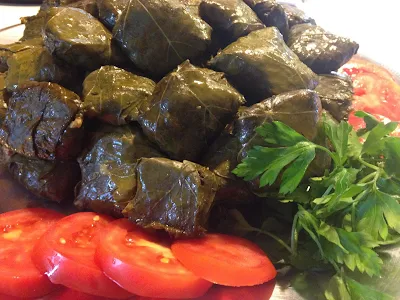
•Dolmeh (stuffed leaves): a meal prepared with rice, ground beef, split pea and special vegetables and wrapped in leaves like grape or cabbage leaves.
Dolme


Integral parts of Iranian dishes are Rice and Khoresh, or “Lamb stew” which is prepared with meat, oil and vegetables. Chelo is rice served with oil or butter and eaten with kebab or other khoresh.
 
Integral parts of Iranian dishes are Rice and Khoresh, or “Lamb stew” which is prepared with meat, oil and vegetables. Chelo is rice served with oil or butter and eaten with kebab or other khoresh.
Chelo Khoresh


Basloqh is a kind of traditional sweet prepared with starch, water, sugar, cardamom, coconut powder and butter, mostly in Azerbaijan.
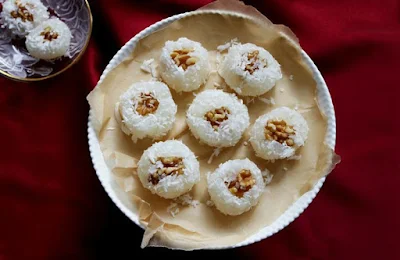
 
Basloqh is a kind of traditional sweet prepared with starch, water, sugar, cardamom, coconut powder and butter, mostly in Azerbaijan.
Baslogh


•Abgosht (Dizzi) is a delicious meal with meat, chickpea and beans and is served traditionally in restaurants.


•Abgosht (Dizzi) is a delicious meal with meat, chickpea and beans and is served traditionally in restaurants.   •Zulbia, which looks a bit like a multi stranded pretzel, and Bamieh are the most popular cookies in Ramadan, fasting month.
Dizi
 •Zulbia, which looks a bit like a multi stranded pretzel, and Bamieh are the most popular cookies in Ramadan,fasting month.


 Moreover, some kinds of food are frequently prepared for distribution to the community as a charitable religious act. When a sheep is slaughtered for a special occasion it is common to give meat to all of one's neighbors, to give thanks for the fulfillment of a desire. Likewise, during the months of Muharram and Safar, communal meals are paid for by charitable individuals. The most common food served on these occasions is a rice made with yellow peas and meat.Iran is home to some of the world's finest restaurants. While traveling in Iran during especial months, do not miss the chance of tasting tasty Iranian food.

Sunday, January 14, 2018

Be Familiar with Food and Table Etiquette in Iran


Many people who have never traveled in Iran may come to the conclusion that it is a bona fide paradise for travelers. If you’re looking for a destination where you can look forward to lots of pleasant interactions, head to fantastic Iran known as the home of some of the world’s friendliest people. Of course many of its other stereotypes also holds true, like its magnificent monument, four-season weather, dazzling islands, and tasty food. 


Iran is often referred to as the land of hospitality, and while it may be a cliché, it also happens to be quite true. On the whole, Iran is a very welcoming, friendly country, particularly when you get outside the large tourist centers like Shiraz and Isfahan. One of the world-famous customs of our culture is to have some people over for a meal. Even the warmth and hospitality of the rural people in isolated villages will surprise the travelers. As a foreigner you may encounter locals who invite you to their homes and ask you to dine with them. According to Iranian culture, the host and guest have duties towards each other that they must observe. You’d better to be familiar with these customs, not to mean rude unintentionally, while you have supper in a cozy Iranian house. 

According to Iranian culture, the host and guest have duties towards each other that they must observe
Iranian dinner

Meals are generally served family-style and Iranians are rather formal. Although some meals in the home are served on the floor and most tablecloth are set with a spoon and fork only, it does not indicate a lack of decorum. For Iranians, Meals are an important time to realize how lucky they are to have enough to eat, and give God thanks.  It’s more polite to keep quite while the host is reciting short prayers before the meal. Next, as a guest, you will be invited to start eating first. One of the ethical duties of the Iranian host is to eat with his guests and not to stop eating until all the guests eat their foods.  It’s hard to believe but there is often more food than you can eat. Part of Iranian hospitality is to shower guests with abundance. The main typical Persian dishes are a blend of rice with meat, chicken or fish but rice can also be prepared as the main dish. If the host find your dish empty, expect to be offered second and even third helpings. Initial refusals will be assumed to be polite gestures (taarof) and are not taken seriously. Try to comment on the food if at someone's home - the term “Merc” or “Mamnoon” is used to thank someone for doing something for you. When all ate their food, you can show your politeness by helping the host to clear the table.

If you are interested to sit down with an Iranian family for a delicious dinner that everyone enjoy, Uppersia is eager to arrange a great night for you.

 
According to Iranian culture, the host and guest have duties towards each other that they must observe
Iranian dinner